A Select List of Russian Bells Weighing 36,100 Pounds (1,000 Puds)
or More, with Comparative Weights of Some of the Largest Bells of Asia,
Western Europe, and North America
(After Edward V. Williams, The Bells of Russia: History & Technology
(Princeton Univ. Press: 1985), pp. 183-185.)
NOTE: Sources vary considerably in the weights they cite
for the world's largest bells. The figures given hereshould in most cases
be regarded as approximate. All of the listed Russian bells were presumably
extant at the end of the nineteenth century, and weights for a number
of them are published in N. Priakhin, "Kolokol'nyj zvon': dostoprimechatel'nye
kolokola v' Rossii," Russkii palomnik', no. 19 (1886), pp. 171-
172. Priakhin, unfortunately, does not include dates of founding with
the weights of bells in his list. For some non-Russian bells, see Percival
Price, "Bell," New Grove Dictionary of Music and Musicians 2, ed.
Stanley Sadie (London: Macmillan, 1980), p. 430, table 1: The largest
bell in each of twelve countries; and Percival Price, Bells and Man
(Oxford: Oxford University Press, 1983), 264-273 (App. A: An historical
survey of bells around the world).
Osaka, Japan (1902):
Shi-tenno-ji (temple) 310,000 lbs. notepicture
3.
Lucky Bell
(2000), Pingdingshan, Henan, China: 255,200 lbs
4.
Mingun
(1790): near Mandalay, Burma 195,000 lbs. notepage
5.
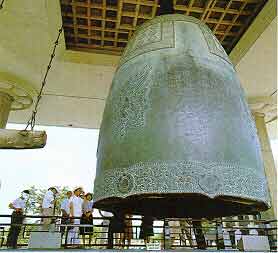
Kyongju, South
Korea (771): "Emelie" or "Emilee" 41,630 lbs. notepicture
6.
Trinity-Sergius
Lavra, Zagorsk, "Tsarsky Kolokol" (not to be confused with the above)
recast in 2004 at 72 metric tons (158,590 lbs); formerly the world's
7th largest bell (1748), at 144,452 lbs.; note
7.
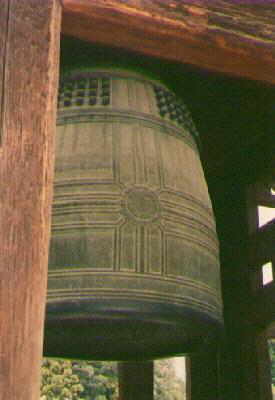
Kyoto, Japan (1633): Chion-in Temple
148,000 lbs. page picture
Shi-Tenno-ji Temple Bell:
This Japanese bell was the largest ever cast in Asia. According to Percival
Price it was melted down in 1942 for its metal (Bells and Man, 273).
Mingun: Today the stationary
Mingun Bell is considered the world's largest ringing bell and is second
only to Tsar- Kolokol in weight. The weight cited for the Mingun Bell
varies considerably. It has been placed as high as 101.4 tons (202,800
pounds) and as low as 87 tons (174,000 pounds). (David A. Boehm, ed. Guinness
1984 Book of World Records [New York: Sterling Publishing Co., 1984],
170; and Wilhelm Klein, Burma, 2d ed. [Hong Kong: Apa Productions,
1982], 201.)
Emilee: Located at Kyong-Ju
National Museum. This bell is about three meters high and two meters in
diameter. The story is that they could get no sound from it until a Buddhist
monk had a dream that they had to sacrifice a young child to get any sound.
So they threw a young girl into the melting pot, and the last thing they
heard was her desperate cry, "Emilee" ("Mother!").
From that day, bell sounds like the cry of that child, and the bell has
its name from this.
Tsarsky
Kolokol: This is the Russian bell frequently cited in Western sources
in or near Moscow under the name "Trotzkoi." It is so named because it
hung in the bell tower of the Trinity-Sergius Lavra near Moscow until
removed and melted down in 1930. Recast in 2004 at 72 metric tons (144,452
lbs).
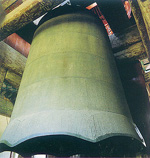
This Nara bell may have
been recast in 1239. (H. Batterson Boger, The Traditional Arts of Japan
[New York: Bonanza Books, 1964], 101.)
Estimates of this Peking
bell's weight vary greatly. In publications from the People's Republic
of China it is officially cited as 46.5 tons (93, 000 pounds). (Liu Junwen,
Beijing: China's Ancient and Modern Capital [Beijing: Foreign Languages
Press, 1982], 143.) Other sources have reported its weight as 106,000
and 120,000 pounds.
Savvino-Storozhevsky:
This bell was broken in 1941; its fragments are in Zvenigorod.
"Peters glocke " is considered
the heaviest swinging bell in the world.
"Kaiserglocke" was
destroyed during World War I to provide metal for war munitions but was
replaced in 1925 by "Petersglocke " (Ernest Morris, Bells of All Nations
[London: Robert Hale, 1951], 64).
"Pummerin" means "boomer.
" Pummerin I, a bell of about the same weight cast in 1711, was destroyed
during an air raid in 1945.
The Tobol'sk bell at 1,011
puds, 22 funts, was the largest in Siberia (N. R., "0 kolokolakh' i o
kolokol'nom' iskusstve," Moskovskiia vedomosti, no. 51 [Saturday,
April 29, 1850], p. 587n.).